Family Structure and Marriage
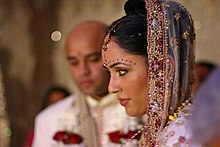

A bride during a traditional Hindu wedding ceremony in Punjab.
For generations, India has a prevailing tradition of the joint family system. It is a game extended members of a family – parents, children, the children's spouses and their offspring, etc. – live together. Usually, the oldest male member is the head in the joint Indian family system. He mostly makes all important decisions and rules, and other family members are likely abide by them. [35]
In a 1966 study, Orenstein and Micklin analysed India's population data and family structure. Their studies suggest that Indian household sizes had remained similar over the 1911 to 1951 period. Thereafter, with urbanisation and economic development, India has witnessed a break up of traditional joint family into more nuclear-like families.[36][37] Sinha, in his book, after summarising the numerous sociological studies done on Indian family, notes that over the last 60 years, the cultural trend in most parts of India has been an accelerated change from joint family to nuclear families, much like population trends in other parts of the world. The traditional large joint family in India, in the 1990s, accounted for a small percent of Indian households, and on average had lower per capita household income. He finds that joint family still persists in some areas and in certain conditions, in part due to cultural traditions and in part due to practical factors.[36] Youth in lower socio-economic classes are more inclined to spend time with their families than their peers due to differing ideologies in rural and urban parenting.[38] With the spread of education and growth of economics, the traditional joint-family system is breaking down rapidly across India and attitude towards the working women has changed.

No comments:
Post a Comment